



















Clarksville Weekly Market Snapshot from Frazier Allen for the week of August 3rd, 2014

 Clarksville, TN – As was widely anticipated, the Federal Open Market Committee tapered another $10 billion from the monthly pace of asset purchases (now at $25 billion, with the program on track to be completed at the end of October).
The Fed provided no additional guidance on short-term interest rates, but repeated that the federal funds rate target would likely remain exceptionally low for “a considerable period” after the asset purchase program ends and that economic conditions will likely warrant a below-normal federal funds rate even as the Fed nears its employment and inflation goals.

Frazier Allen
Real GDP rose at a stronger-than-expected 4.0% annual rate in the advance estimate for 2Q14, while the first quarter figure was revised from -2.9% to -2.1% (first half GDP growth now stands at a 0.9% annual rate, vs. expectations of about 0% before the report).
A little over 40% of the second quarter’s growth came from a more rapid pace of inventory accumulation – a pace that will be difficult to sustain in the quarter ahead.
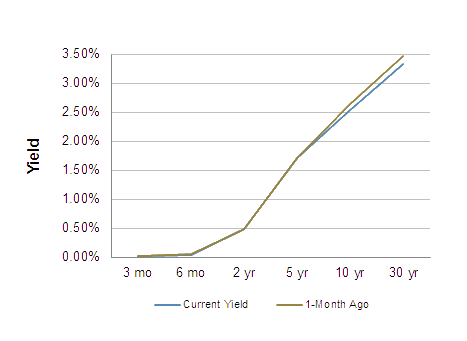
Domestic Final Sales, a measure of underlying domestic demand, rose 2.8% (vs. +0.7% in 1Q14). The 2Q14 GDP figure should not change the Fed’s policy outlook – but market participants feared that the Fed may move sooner rather than later, pushing long-term Treasury yields higher and hammering the stock market.
The July Employment Report was moderately strong. Nonfarm payrolls rose by 209,000, less than expected, but the two previous months were revised a net 15,000 higher. The unemployment rate edged up to 6.2% (vs. 6.1% in June and 6.3% in May) reflecting a small increase in labor force participation (which was probably just statistical noise). Average hourly earnings were flat, up 2.0% year-over-year (note that the CPI rose 2.1% over the 12 months ending in June).
Next week, the economic calendar thins out considerably, and that’s a good thing, as it may take some time for the markets to digest all of the recent economic data. The ISM Non-Manufacturing Index has some potential to surprise, but is unlikely to add much to the overall picture of the economy. Productivity figures should rebound in 2Q14.
Indices
| Last | Last Week | YTD return % | |
| DJIA | 16563.30 | 17083.80 | -0.08% |
| NASDAQ | 4369.77 | 4472.11 | 4.63% |
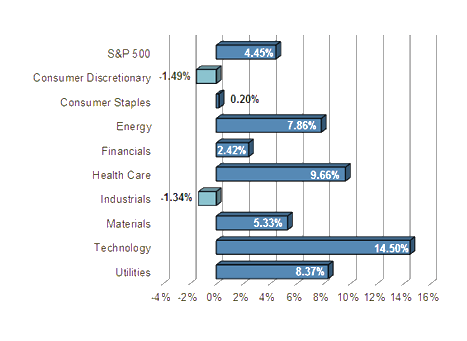
| S&P 500 | 1930.67 | 1987.98 | 4.45% |
| MSCI EAFE | 1932.59 | 1969.21 | 0.89% |
| Russell 2000 | 1120.07 | 1156.26 | -3.74% |
Consumer Money Rates
| Last | 1-year ago | |
| Prime Rate | 3.25 | 3.25 |
| Fed Funds | 0.08 | 0.08 |
| 30-year mortgage | 4.12 | 4.39 |
Currencies
| Last | 1-year ago | |
| Dollars per British Pound | 1.688 | 1.520 |
| Dollars per Euro | 1.339 | 1.325 |
| Japanese Yen per Dollar | 102.860 | 97.630 |
| Canadian Dollars per Dollar | 1.092 | 1.030 |
| Mexican Peso per Dollar | 13.194 | 12.800 |
Commodities
| Last | 1-year ago | |
| Crude Oil | 98.17 | 105.03 |
| Gold | 1295.10 | 1332.17 |
Bond Rates
| Last | 1-month ago | |
| 2-year treasury | 0.49 | 0.48 |
| 10-year treasury | 2.54 | 2.63 |
| 10-year municipal (TEY) | 3.46 | 3.57 |
Treasury Yield Curve – 8/1/2014
S&P Sector Performance (YTD) – 8/1/2014
Economic Calendar
| August 5th | — | ISM Non-Manufacturing Index (July) |
| August 8th | — | Nonfarm Productivity (2Q14, preliminary) |
| August 21st | — | KC Fed Monetary Policy Symposium (Jackson Hole) |
| September 1st | — | Labor Day (markets closed) |
| September 5th | — | Employment Report (August) |
| September 17th | — | FOMC Policy Decision, Yellen Press Conference |
Important Disclosures
[320left]Past performance is not a guarantee of future results. There are special risks involved with global investing related to market and currency fluctuations, economic and political instability, and different financial accounting standards. The above material has been obtained from sources considered reliable, but we do not guarantee that it is accurate or complete. There is no assurance that any trends mentioned will continue in the future. While interest on municipal bonds is generally exempt from federal income tax, it may be subject to the federal alternative minimum tax, state or local taxes. In addition, certain municipal bonds (such as Build America Bonds) are issued without a federal tax exemption, which subjects the related interest income to federal income tax. Investing involves risk and investors may incur a profit or a loss.
US government bonds and treasury bills are guaranteed by the US government and, if held to maturity, offer a fixed rate of return and guaranteed principal value. US government bonds are issued and guaranteed as to the timely payment of principal and interest by the federal government. Treasury bills are certificates reflecting short-term (less than one year) obligations of the US government.
Commodities trading is generally considered speculative because of the significant potential for investment loss. Markets for commodities are likely to be volatile and there may be sharp price fluctuations even during periods when prices overall are rising. Specific sector investing can be subject to different and greater risks than more diversified investments.
Tax Equiv Muni yields (TEY) assume a 35% tax rate on triple-A rated, tax-exempt insured revenue bonds.
 Material prepared by Raymond James for use by its financial advisors.
The information contained herein has been obtained from sources considered reliable, but we do not guarantee that the foregoing material is accurate or complete. Data source: Bloomberg, as of close of business July 31st, 2014.
©2014 Raymond James Financial Services, Inc. member FINRA / SIPC.




Comments
Feel free to leave a comment...
and oh, if you want a pic to show with your comment, go get a gravatar!
You must be logged in to post a comment.