



















The Weekly Market Snapshot from Frazier Allen for the week of February 5th, 2012


Market Commentary by Scott J. Brown, Ph.D., Chief Economist

Scott J. Brown Ph.D., Chief Economist Raymond James Investment Services
The economic data were mixed, but remained consistent with moderate growth in the near term. Consumer confidence fell in January. Motor vehicle sales picked up. Home prices were still falling in November. Construction spending improved in December (likely reflecting mild weather). The January Employment Report was stronger than expected, helped by mild weather. Nonfarm payrolls rose by 243,000 and the two previous months were revised a net 60,000 higher (note that payrolls fell by 2.689 million in January before seasonal adjustment).
The unemployment rate fell to 8.3%, from 8.5% in December and 9.1% a year ago, due largely to a drop in labor force participation. The employment/population ratio held steady at 58.5%, little changed over the last two years. The Household Survey results noted that 206,000 people were not able to work during the January survey period due to adverse weather, vs. a 425,000 average over the last five Januarys (this figure is not directly comparable to the payroll numbers, but it gives you an idea of the magnitude of the weather impact).
In his testimony to the House Budget Committee, Fed Chairman Bernanke noted that the recovery has been “frustratingly slow” and remains vulnerable to shocks. He said “the outlook remains uncertain” and needs to be monitored closely. Bernanke said that the federal budget deficit will decrease as the economy recovers and tax revenues rebound. However, even after economic conditions return to normal, “the nation will still face a sizeable structural budget gap.” And then, even if discretionary spending were cut to zero, we would still have a deficit. When asked if the Fed’s dual targeting system implied that the Fed would tolerate higher inflation in the short term in order to push unemployment lower, Bernanke said that the Fed will not seek to raise inflation.
Next week, the economic calendar thins out considerably. Bernanke testifies on Tuesday, but this is expected to be a repeat of what he gave the House Budget Committee. The markets typically don’t pay much attention to the monthly trade data, but the December figures have some implications for GDP revisions.
Indices
| Last | Last Week | YTD return % | |
| DJIA | 12705.41 | 12734.63 | 3.99% |
| NASDAQ | 2859.68 | 2805.28 | 9.77% |
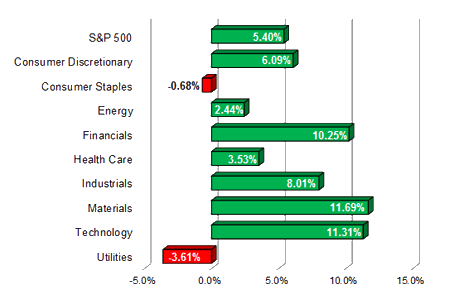
| S&P 500 | 1325.54 | 1318.43 | 5.40% |
| MSCI EAFE | 1518.58 | 1505.67 | 7.51% |
| Russell 2000 | 812.89 | 792.91 | 9.71% |
Consumer Money Rates
| Last | 1-year ago | |
| Prime Rate | 3.25 | 3.25 |
| Fed Funds | 0.11 | 0.18 |
| 30-year mortgage | 3.85 | 4.84 |
Currencies
| Last | 1-year ago | |
| Dollars per British Pound | 1.581 | 1.617 |
| Dollars per Euro | 1.315 | 1.379 |
| Japanese Yen per Dollar | 76.160 | 81.670 |
| Canadian Dollars per Dollar | 1.000 | 0.989 |
| Mexican Peso per Dollar | 12.829 | 12.030 |
Commodities
| Last | 1-year ago | |
| Crude Oil | 96.36 | 90.86 |
| Gold | 1755.33 | 1329.98 |
Bond Rates
| Last | 1-month ago | |
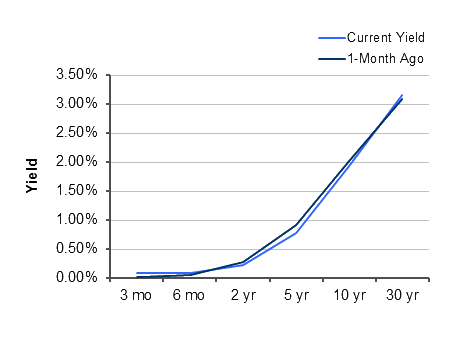
| 2-year treasury | 0.23 | 0.27 |
| 10-year treasury | 1.93 | 2.01 |
| 10-year municipal (TEY) | 2.66 | 2.89 |
Treasury Yield Curve – 2/3/2012
S&P Sector Performance (YTD) – 2/3/2012
Economic Calendar
| February 7th |
— |
Bernanke Testimony (Senate Budget Committee) |
| February 9th |
— |
Jobless Claims (week ending February 4th) |
| February 10th |
— |
Trade Balance (December) Consumer Sentiment (mid-January) |
| February 14th |
— |
Retail Sales (January) |
| February 15th |
— |
Industrial Production (January) |
| February 16th |
— |
Producer Price Index (January) Building Permits, Housing Starts (January) |
| February 17th |
— |
Consumer Price Index (January) |
| February 20th |
— |
President’s Day Holiday (markets closed) |
| March 9th |
— |
Employment Report (February) |
| March 13th |
— |
FOMC Policy Decision (no press briefing) |
Important Disclosures
Past performance is not a guarantee of future results. There are special risks involved with global investing related to market and currency fluctuations, economic and political instability, and different financial accounting standards. The above material has been obtained from sources considered reliable, but we do not guarantee that it is accurate or complete. There is no assurance that any trends mentioned will continue in the future. While interest on municipal bonds is generally exempt from federal income tax, it may be subject to the federal alternative minimum tax, state or local taxes. In addition, certain municipal bonds (such as Build America Bonds) are issued without a federal tax exemption, which subjects the related interest income to federal income tax. Investing involves risk and investors may incur a profit or a loss.
US government bonds and treasury bills are guaranteed by the US government and, if held to maturity, offer a fixed rate of return and guaranteed principal value. US government bonds are issued and guaranteed as to the timely payment of principal and interest by the federal government. Treasury bills are certificates reflecting short-term (less than one year) obligations of the US government.
Commodities trading is generally considered speculative because of the significant potential for investment loss. Markets for commodities are likely to be volatile and there may be sharp price fluctuations even during periods when prices overall are rising. Specific sector investing can be subject to different and greater risks than more diversified investments.
Tax Equiv Muni yields (TEY) assume a 35% tax rate on triple-A rated, tax-exempt insured revenue bonds.
 Material prepared by Raymond James for use by its financial advisors.
The information contained herein has been obtained from sources considered reliable, but we do not guarantee that the foregoing material is accurate or complete. Data source: Bloomberg, as of close of business February 2nd, 2012.
©2012 Raymond James Financial Services, Inc. member FINRA / SIPC.




Comments
Feel free to leave a comment...
and oh, if you want a pic to show with your comment, go get a gravatar!
You must be logged in to post a comment.