



















The Weekly Market Snapshot from Frazier Allen


Market Commentary by Scott J. Brown, Ph.D., Chief Economist

Scott J. Brown Ph.D., Chief Economist Raymond James Investment Services
The economic calendar was thin. The stock market continued to shrug off worries for the most part. The threat of a government shutdown and a continued surge in oil prices did not seem to generate much concern, but another earthquake in Japan caused a brief reaction in U.S. markets. The European Central Bank raised short-term interest rates, as expected. Oil prices continued higher. West Texas Intermediate rose to over $110.00 per barrel, but Brent (which is more representative of the global price of oil and more important for gasoline prices) exceeded $125.00. Gasoline futures suggested that the average retail price may near $4.00 per gallon soon.
The minutes of the March 15th FOMC policy meeting showed that Fed officials felt that the inflationary impact from higher food and energy prices was likely to be “transitory.” Risks to the growth outlook were seen as “roughly balanced,” but officials noted that a more substantial increase in oil prices would add downside risk to growth and upside risk to inflation.
Next week, a busy week in terms of the economic data. The focus is likely to be on the reports on retail sales and consumer prices. Retail sales will be boosted somewhat by higher gasoline prices, but spending on other things should be moderate. Higher gasoline prices will boost the headline CPI. Core inflation has been trending somewhat higher in early 2011, but that’s not a bad thing (core inflation trended too low for the Fed’s comfort in 2010). There will be other things for market participants to worry about (a possible government shutdown and higher oil prices).
Indices
| Last | Last Week | YTD return % | |
| DJIA | 12409.49 | 12319.73 | 7.19% |
| NASDAQ | 2796.14 | 2781.07 | 5.40% |
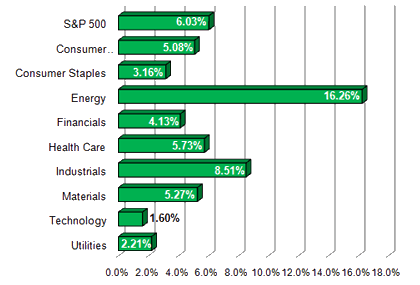
| S&P 500 | 1333.51 | 1325.83 | 6.03% |
| MSCI EAFE | 1717.73 | 1702.55 | 3.58% |
| Russell 2000 | 849.44 | 843.55 | 8.40% |
Consumer Money Rates
| Last | 1-year ago | |
| Prime Rate | 3.25 | 3.25 |
| Fed Funds | 0.10 | 0.20 |
| 30-year mortgage | 4.90 | 5.24 |
Currencies
| Last | 1-year ago | |
| Dollars per British Pound | 1.632 | 1.525 |
| Dollars per Euro | 1.430 | 1.336 |
| Japanese Yen per Dollar | 85.000 | 93.530 |
| Canadian Dollars per Dollar | 0.959 | 1.002 |
| Mexican Peso per Dollar | 11.787 | 12.244 |
Commodities
| Last | 1-year ago | |
| Crude Oil | 110.30 | 85.88 |
| Gold | 1455.75 | 1152.40 |
Bond Rates
| Last | 1-month ago | |
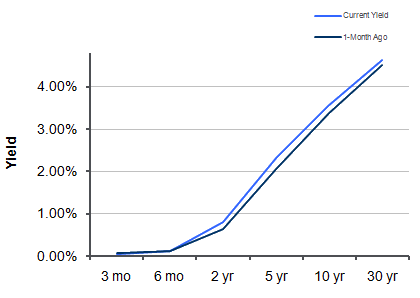
| 2-year treasury | 0.81 | 0.64 |
| 10-year treasury | 3.57 | 3.38 |
| 10-year municipal (TEY) | 5.28 | 4.88 |
Treasury Yield Curve – 4/8/2011
S&P Sector Performance (YTD) – 4/8/2011
Economic Calendar
| April 11th | — | IMF World Economic Outlook |
| April 12th | — | Small Business Sentiment (March) Import Prices (March) Trade Balance (February) |
| April 13th | — | Retail Sales (March) Fed Beige Book |
| April 14th | — | Jobless Claims (week ending April 9th) Producer Price Index (March) |
| April 15th | — | Consumer Price Index (March) Industrial Production (March) Consumer Sentiment (mid-April) |
| April 19th | — | Building Permits, Housing Starts (March) |
| April 20th | — | Existing Home Sales (March) |
| April 21st | — | Leading Economic Indicators (March) |
| April 22nd | — | Good Friday Holiday (markets closed) |
| April 26th-27th | — | FOMC Meeting Bernanke Press Conference |
| April 28th | — | Real GDP (Q1 2011, advance estimate) |
| May 6th | — | Employment Report (April) |
Important Disclosures
Past performance is not a guarantee of future results. There are special risks involved with global investing related to market and currency fluctuations, economic and political instability, and different financial accounting standards. The above material has been obtained from sources considered reliable, but we do not guarantee that it is accurate or complete. There is no assurance that any trends mentioned will continue in the future. While interest on municipal bonds is generally exempt from federal income tax, it may be subject to the federal alternative minimum tax, state or local taxes. In addition, certain municipal bonds (such as Build America Bonds) are issued without a federal tax exemption, which subjects the related interest income to federal income tax. Investing involves risk and investors may incur a profit or a loss.
US government bonds and treasury bills are guaranteed by the US government and, if held to maturity, offer a fixed rate of return and guaranteed principal value. US government bonds are issued and guaranteed as to the timely payment of principal and interest by the federal government. Treasury bills are certificates reflecting short-term (less than one year) obligations of the US government.
Commodities trading is generally considered speculative because of the significant potential for investment loss. Markets for commodities are likely to be volatile and there may be sharp price fluctuations even during periods when prices overall are rising. Specific sector investing can be subject to different and greater risks than more diversified investments.
Tax Equiv Muni yields (TEY) assume a 35% tax rate on triple-A rated, tax-exempt insured revenue bonds.
 Material prepared by Raymond James for use by its financial advisors.
The information contained herein has been obtained from sources considered reliable, but we do not guarantee that the foregoing material is accurate or complete. Data source: Bloomberg, as of close of business April 7th, 2011.
©2011 Raymond James Financial Services, Inc. member FINRA / SIPC.




Comments
Feel free to leave a comment...
and oh, if you want a pic to show with your comment, go get a gravatar!
You must be logged in to post a comment.