



















The Weekly Market Snapshot from Frazier Allen for the week of February 12th, 2012
February 12, 2012

Market Commentary by Scott J. Brown, Ph.D., Chief Economist

Scott J. Brown Ph.D., Chief Economist Raymond James Investment Services
Global equity markets rallied on progress on a Greek bailout package, but reacted negatively as Greece stumbled as it approached the finish line. In the U.S., investors began to question whether the stock market rally has gone too fast in 2012.
The economic calendar was thin. Consumer credit rose sharply in December, following a strong gain in November, apparently reflecting the improvement in motor vehicle sales. The trade deficit was narrower than expected in December (implying, all else equal, a small upward revision to the 4Q11 GDP growth estimate).
Five big banks reached a foreclosure settlement with the attorneys general of 49 states and the Obama administration, which will provide mortgage adjustments for about 10% of those underwater on their mortgages and distribute checks of around $2000 to about 750,000 who were foreclosed upon through faulty or fraudulent practices. The settlement should help the housing sector to some extent, but is not expected to lead to a sharp recovery.
Next week, the economic calendar turns busy. The focus is likely to be on the reports of retail sales and consumer prices. Seasonal adjustment may magnify the impact of unusually mild weather in January (likely apparent in residential construction and industrial production). The White House’s Office of Management and Budget will release its budget outlook on Monday.
Significant deficit reduction is expected in this plan, following required discretionary spending cuts from last year’s Budget Control Act, but it will be interesting to see what gets cut and whether there will be a push to soften or postpone scheduled tax increases (the Bush tax cuts and the reduction in payroll taxes). Note that the payroll tax reduction, which is set to expire at the end of February, has yet to be extended for the full calendar year.
Indices
| Last | Last Week | YTD return % | |
| DJIA | 12890.461 | 12705.41 | 5.51% |
| NASDAQ | 2927.23 | 2859.68 | 12.36% |
| S&P 500 | 1351.95 | 1325.54 | 7.50% |
| MSCI EAFE | 1549.80 | 1518.58 | 9.72% |
| Russell 2000 | 824.99 | 812.89 | 11.35% |
Consumer Money Rates
| Last | 1-year ago | |
| Prime Rate | 3.25 | 3.25 |
| Fed Funds | 0.12 | 0.13 |
| 30-year mortgage | 3.89 | 5.06 |
Currencies
| Last | 1-year ago | |
| Dollars per British Pound | 1.583 | 1.610 |
| Dollars per Euro | 1.330 | 1.371 |
| Japanese Yen per Dollar | 77.530 | 82.370 |
| Canadian Dollars per Dollar | 0.994 | 0.994 |
| Mexican Peso per Dollar | 12.712 | 12.051 |
Commodities
| Last | 1-year ago | |
| Crude Oil | 99.84 | 86.71 |
| Gold | 1739.40 | 1363.03 |
[470center]
Bond Rates
| Last | 1-month ago | |
| 2-year treasury | 0.27 | 0.22 |
| 10-year treasury | 1.98 | 1.86 |
| 10-year municipal (TEY) | 2.85 | 2.85 |
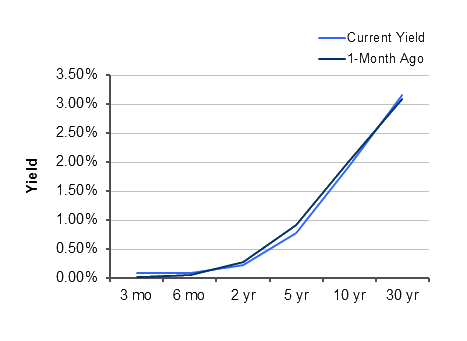
Treasury Yield Curve – 2/10/2012

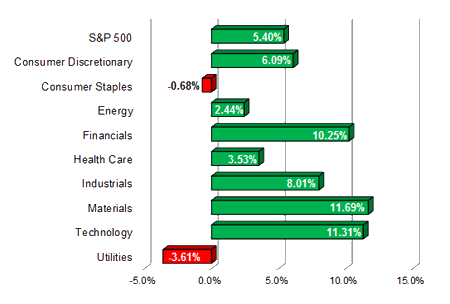
S&P Sector Performance (YTD) – 2/10/2012

Economic Calendar
| February 13th |
— |
OMB Budget Outlook |
| February 14th |
— |
Small Business Optimism (January) Import Prices (January) Retail Sales (January |
| February 15th |
— |
Empire St. Manufacturing Index (February) Industrial Production (January) Homebuilder Sentiment (February) FOMC Minutes (January 1/24th-25th) |
| February 16th |
— |
Jobless Claims (week ending February 11th) Producer Price Index (January) Building Permits, Housing Starts (January) Philadelphia Fed Index (February) |
| February 17th |
— |
Consumer Price Index (January) Leading Economic Indicators (January) |
| February 20th |
— |
President’s Day Holiday (markets closed) |
| March 9th |
— |
Employment Report (February) |
| March 13th |
— |
FOMC Policy Decision (no press briefing) |
Treasury Yield Curve – 2/3/2012
S&P Sector Performance (YTD) – 2/3/2012
Economic Calendar
| February 7th |
— |
Bernanke Testimony (Senate Budget Committee) |
| February 9th |
— |
Jobless Claims (week ending February 4th) |
| February 10th |
— |
Trade Balance (December) Consumer Sentiment (mid-January) |
| February 14th |
— |
Retail Sales (January) |
| February 15th |
— |
Industrial Production (January) |
| February 16th |
— |
Producer Price Index (January) Building Permits, Housing Starts (January) |
| February 17th |
— |
Consumer Price Index (January) |
| February 20th |
— |
President’s Day Holiday (markets closed) |
| March 9th |
— |
Employment Report (February) |
| March 13th |
— |
FOMC Policy Decision (no press briefing) |
Important Disclosures
Past performance is not a guarantee of future results. There are special risks involved with global investing related to market and currency fluctuations, economic and political instability, and different financial accounting standards. The above material has been obtained from sources considered reliable, but we do not guarantee that it is accurate or complete. There is no assurance that any trends mentioned will continue in the future. While interest on municipal bonds is generally exempt from federal income tax, it may be subject to the federal alternative minimum tax, state or local taxes. In addition, certain municipal bonds (such as Build America Bonds) are issued without a federal tax exemption, which subjects the related interest income to federal income tax. Investing involves risk and investors may incur a profit or a loss.
US government bonds and treasury bills are guaranteed by the US government and, if held to maturity, offer a fixed rate of return and guaranteed principal value. US government bonds are issued and guaranteed as to the timely payment of principal and interest by the federal government. Treasury bills are certificates reflecting short-term (less than one year) obligations of the US government.
Commodities trading is generally considered speculative because of the significant potential for investment loss. Markets for commodities are likely to be volatile and there may be sharp price fluctuations even during periods when prices overall are rising. Specific sector investing can be subject to different and greater risks than more diversified investments.
Tax Equiv Muni yields (TEY) assume a 35% tax rate on triple-A rated, tax-exempt insured revenue bonds.
 Material prepared by Raymond James for use by its financial advisors.
The information contained herein has been obtained from sources considered reliable, but we do not guarantee that the foregoing material is accurate or complete. Data source: Bloomberg, as of close of business February 9th, 2012.
©2012 Raymond James Financial Services, Inc. member FINRA / SIPC.
The Weekly Market Snapshot from Frazier Allen for the week of February 5th, 2012
February 5, 2012
Market Commentary by Scott J. Brown, Ph.D., Chief Economist
Scott J. Brown Ph.D., Chief Economist Raymond James Investment Services
The economic data were mixed, but remained consistent with moderate growth in the near term. Consumer confidence fell in January. Motor vehicle sales picked up. Home prices were still falling in November. Construction spending improved in December (likely reflecting mild weather). The January Employment Report was stronger than expected, helped by mild weather. Nonfarm payrolls rose by 243,000 and the two previous months were revised a net 60,000 higher (note that payrolls fell by 2.689 million in January before seasonal adjustment).
The unemployment rate fell to 8.3%, from 8.5% in December and 9.1% a year ago, due largely to a drop in labor force participation. The employment/population ratio held steady at 58.5%, little changed over the last two years. The Household Survey results noted that 206,000 people were not able to work during the January survey period due to adverse weather, vs. a 425,000 average over the last five Januarys (this figure is not directly comparable to the payroll numbers, but it gives you an idea of the magnitude of the weather impact). [Read more]
The Weekly Market Snapshot from Frazier Allen for the week of January 29th, 2012
January 29, 2012
Market Commentary by Scott J. Brown, Ph.D., Chief Economist
Scott J. Brown Ph.D., Chief Economist Raymond James Investment Services
The Federal Open Market Committee left short-term interest rates unchanged and did not embark on another round of asset purchases. No surprise there. However, the FOMC lengthened the period it expects to keep rates exceptionally low: the FOMC “currently anticipates that economic conditions – including low rates of resource utilization and a subdued outlook for inflation over the medium run – are likely to warrant exceptionally low levels for the federal funds rate at least through late 2014” (vs. the previous “through mid-2013”).
Keeping to its dual mandate (price stability and maximum sustainable employment) the Fed adopted an explicit inflation target (inflation in the PCE Price Index at 2% per year) and a soft target for employment (currently, an unemployment rate between 5.2% and 6.0%). In the post-meeting press briefing, Chairman Bernanke said that officials were still debating whether to increase the Fed’s asset purchases. [Read more]
The Weekly Market Snapshot from Frazier Allen for the week of January 22nd, 2012
January 22, 2012
Market Commentary by Scott J. Brown, Ph.D., Chief Economist
Scott J. Brown Ph.D., Chief Economist Raymond James Investment Services
The data remained consistent with moderate economic growth in the near term. Industrial production rose 0.4% in December, but was held back by a 2.7% decline in the output of utilities (a function of moderate temperatures) – manufacturing output rose 0.9%, partly reflecting a rebound from a soft November. Residential construction figures were mixed, with an improving trend in single-family housing starts and building permits, but softness in the multi-family sector (which is volatile).
Note that seasonal adjustment may have exaggerated the impact of mild weather. The Consumer Price Index was unchanged for a second consecutive month in December, up 3.0% year-over-year (vs. +1.5% in 2010). Ex-food & energy, the CPI rose 0.1%, up 2.2% in 2011 (vs. a historic low of +0.8% in 2010). [Read more]
The Weekly Market Snapshot from Frazier Allen for the week of January 15th, 2012
January 15, 2012
Market Commentary by Scott J. Brown, Ph.D., Chief Economist
Scott J. Brown Ph.D., Chief Economist Raymond James Investment Services
The economic calendar was thin. Retail sales disappointed in December, rising just 0.1%. However, sales rose 0.3% if one excludes the 1.6% decline in gasoline sales (which reflected lower gasoline prices). In addition, November sales were revised slightly higher. Auto dealership sales advanced 1.5% last month. Sales of building materials rose 1.6%. Core retail sales, which exclude autos, building materials, and gasoline, slipped 0.2%, but still advanced at a somewhat fast pace in 4Q11. Jobless claims rose sharply, but it’s not unusually to see large week-to-week swings this time of year (due to the difficulties in seasonal adjustment).
Expectations for Europe varied, with some concern about the pace of reforms in Greece and rumors of possible downgrades of European sovereign debt. A three-day weekend may have limited the amount of risk-taking in the U.S., weakening share prices. [Read more]
The Weekly Market Snapshot from Frazier Allen for the week of January 8th, 2012
January 8, 2012
Market Commentary by Scott J. Brown, Ph.D., Chief Economist
Scott J. Brown Ph.D., Chief Economist Raymond James Investment Services
The economic data were generally better. The ISM manufacturing and non-manufacturing indices each picked up in December, although levels remained consistent with only moderate economic growth. The December Employment report was moderately strong. Nonfarm payrolls rose by 200,000 (vs. a median forecast of +150,000), but was likely boosted by the seasonal adjustment (unadjusted payrolls fell by 219,000). The two previous months were revised a net 12,000 lower. Private-sector payrolls rose by 212,000. State and local government continued to shed jobs (-14,000), but the pace of decline has been moderating as tax revenues improve.
The unemployment rate fell to 8.5%, from a revised 8.7% in November and 9.4% a year ago. The broader unemployment rate (U-6), which includes discouraged workers and part-time workers who would rather half full-time employment, fell to 15.2%, vs. 15.6% in November and 16.6% a year ago. The employment-population ratio held steady at 58.5%, vs. 58.3% a year ago. [Read more]
The Weekly Market Snapshot from Frazier Allen for the week of January 3rd, 2012
January 3, 2012
Market Commentary by Scott J. Brown, Ph.D., Chief Economist
Scott J. Brown Ph.D., Chief Economist Raymond James Investment Services
Good news on the home front was offset somewhat by concerns about developments overseas as the broad market finished a volatile year essentially unchanged from where it began.
Consumers were generally upbeat, with the Conference Board’s monthly consumer confidence index for December rising to 64.5, up from a 55.2 reading in November and reaching levels last seen in the spring. That confidence, aided by deep discounting and extended hours from retailers, translated into better than expected holiday sales. A shopping center trade group said revenues rose about 3.8% in November and December from a year ago.
Other domestic indicators also were positive. The Labor Department’s four-week average of unemployment claims fell to its lowest level since June 2008, manufacturing activity in the Midwest remained steady in December after rising sharply in November, and a national index of pending home sales index rose to its highest level in more than 18 months. [Read more]
The Weekly Market Snapshot from Frazier Allen for the week of December 26th
December 26, 2011
Market Commentary by Scott J. Brown, Ph.D., Chief Economist
Scott J. Brown Ph.D., Chief Economist Raymond James Investment Services
The economic data were mixed. Real GDP growth rose at a 1.8% annual rate in 3Q11 (revised down from +2.5% in the advance estimate and +2.0% in the 2nd estimate), with a downward revision to consumer spending growth. Personal income and spending rose modestly in November. Inflation–adjusted consumer spending (70% of GDP) appears to remain on track for a 2.5% to 3.0% annual pace in 4Q11. However, real disposable income was down 0.1% from a year ago. Residential construction and new home sales improved, helped by the seasonal adjustment.
Jobless claims continued to trend at a moderately low level, reflecting fewer-than-normal seasonal layoffs in manufacturing and construction. Existing home sales rose 4.0% in November, but benchmark revisions significantly reduced the level of reported sales back to 2007. Congress finally got around to extending unemployment insurance benefits and the payroll tax reduction, but only for two months. [Read more]
The Weekly Market Snapshot from Frazier Allen for the week of December 18th
December 18, 2011
Market Commentary by Scott J. Brown, Ph.D., Chief Economist
Scott J. Brown Ph.D., Chief Economist Raymond James Investment Services
The economic data were mixed, but stock market participants were generally willing to embrace the good news and ignore the bad. Retail sales rose less than expected in November, but previous figures were revised higher, making it about a wash. The Fed’s regional manufacturing surveys (New York and Philadelphia) were stronger than expected in December, but these surveys don’t measure actual activity.
Industrial production weakened last month and results varied across industries. Initial claims for unemployment insurance benefits fell further, but seasonal adjustment is difficult, making the numbers suspect in December. The Consumer Price Index was flat, up 0.2% ex-food & energy, moderating in recent months after stronger gains earlier this year. Pipeline inflation pressures continued to recede. [Read more]
The Weekly Market Snapshot from Frazier Allen for the week of December 11th
December 11, 2011
Market Commentary by Scott J. Brown, Ph.D., Chief Economist
Scott J. Brown Ph.D., Chief Economist Raymond James Investment Services
The focus remained on Europe, as leaders struggled to come up with a fiscal compact. Results were mixed, with the euro zone economies reaching some agreement, but the United Kingdom opted out. That may set up future conflicts between the European Union and the euro zone countries embedded in it. As expected, the ECB lowered short-term interest rates and took further efforts to boost liquidity. However, ECB President Draghi said that the markets were wrong to interpret his previous comments as signaling that the ECB would do a lot more. Market participants still expect the ECB to come through eventually, despite its reluctance to take on the role of lender of last resort.
The economic calendar was thin. The ISM Non-Manufacturing Index slipped to 52.0 in November, vs. 52.9 in October, consistent with lackluster-to-moderate growth in the overall economy. Consumer sentiment improved in the mid-month assessment for December. [Read more]


