



















Weekly Market Snapshot from Frazier Allen for the week of April 8th, 2013
April 8, 2013

Market Commentary by Scott J. Brown, Ph.D., Chief Economist
 The economic data were generally disappointing. Nonfarm payrolls rose by a disappointing 88,000 in March (median forecast: +200,000), up 759,000 before seasonal adjustment (vs. +901,000 in March 2012). Payroll figures for January and February were revised a net 61,000 higher (adjusted payrolls average a 168,000 monthly gain in 1Q13, roughly the same pace as the last two years).
Mild weather in February may have pulled forward some of March’s strength, but the slowdown could signal a lagged impact of the payroll tax increase. The unemployment rate fell to 7.6% (vs. 7.7% in February and 8.2% a year ago), but this was once again due to a decrease in labor force participation (participation should be rising if the labor market is strengthening, as individuals are lured back into the job market). The employment/population ratio edged down to 58.5%, trending roughly flat over the last few years. [Read more]
Weekly Market Snapshot from Frazier Allen for the week of March 31st, 2013
March 31, 2013
Market Commentary by Scott J. Brown, Ph.D., Chief Economist
The economic data were mixed. Third quarter GDP growth rose at a 0.4% annual rate in 4Q12 (vs. +0.1% in the 2nd estimate and -0.1% in the advance estimate), but consumer spending growth was revised down (suggesting less momentum into 1Q13). Consumer confidence fell in March, with a sharp drop in expectations (which are thought to be a factor in big-ticket purchases). Durable goods orders jumped, reflecting a rebound in aircraft, but were mixed and generally soft otherwise. Home prices continued to rise. Weekly claims for unemployment benefits rose unexpectedly, which could signal a lagged impact from the payroll tax increase and higher gasoline prices, but it’s only one week.
The Dutch finance minister said that the Cyprus bank bailout could serve as a model for other countries, although he tried to walk those comments back shortly after. Most observers see the Cypriot bailout as a disaster and are now looking at the possibility of similar debacles in the smaller eurozone countries (Malta, Slovenia, perhaps even Luxembourg with its outsized banking industry). It’s going to be another long year for Europe. [Read more]
Weekly Market Snapshot from Frazier Allen for the week of March 24th, 2013
March 24, 2013
Market Commentary by Scott J. Brown, Ph.D., Chief Economist
The “Crisis in Cyprus” dampened the U.S. stock market mood early in the week. Why is Cyprus important? Its economy is a little bigger than Scranton. However, like Iceland and Ireland, it has an outsized banking system, several times larger than the overall economy. Even a moderate contraction in the banking system can have a huge impact.
The biggest fear is contagion. The decision to tie aid to a haircut on deposits led to fears of runs on the banks in other countries, but there’s been little evidence of that so far.
There were no surprises from Fed policymakers. The Federal Open Market Committee did not change its forward guidance (on the federal fund rate target, still not expected to start rising until 2015), nor did it alter its asset purchase plans (still $85 billion per month). [Read more]
Weekly Market Snapshot from Frazier Allen for the week of March 17th, 2013
March 17, 2013
Market Commentary by Scott J. Brown, Ph.D., Chief Economist
The economic data were mixed, but the stock market continued to focus on the good news and ignored the rest. Retail sales rose more than expected in February, but results varied across sectors. Industrial production picked up, following a weak January (results varied by industry).
The inflation reports showed some pressure from higher gasoline, as anticipated, and moderate core inflation. Treasury reported a smaller deficit than a year ago. Initial claims for unemployment benefits continued to trend lower. Consumer sentiment fell in the mid-March assessment, with a sharp decline in expectations (down to a 15-month low).
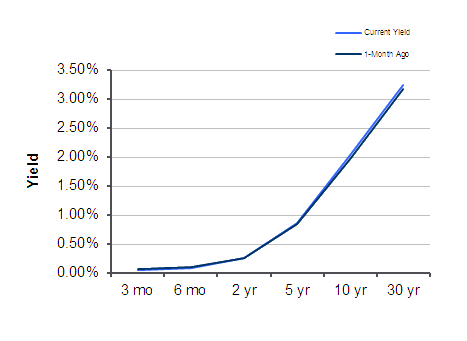
The Dow Jones Industrials Average continued to new record highs, up 10 sessions in a row. In contrast to the optimism expressed in equities, bond yields have remained relatively low.
Next week, housing figures have some market-moving potential, but February is not a “make or break” month for the sector (weather can have an impact). The March figures will be more important. No surprises are expected from the Fed policy meeting on Wednesday.
Officials have had a public debate about the potential costs and benefits of current policy and the settled view is that the benefits (to the labor market, in particular) outweigh the potential that we may see excessive risk-taking and financial instability. The Fed will release revised projections of growth, unemployment, and inflation. Note that the Fed policy announcements will now be made at 2:00pm. On the last meeting of the quarter, the Fed will also release revised projects at 2:00 p.m. and Bernanke’s press briefings will follow at 2:30pm.
Indices
| Last | Last Week | YTD return % | |
| DJIA | 14539.14 | 14329.49 | 10.95% |
| NASDAQ | 3258.93 | 3232.09 | 7.93% |
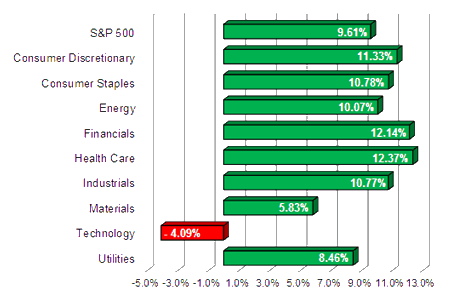
| S&P 500 | 1563.23 | 1544.26 | 9.61% |
| MSCI EAFE | 1699.43 | 1682.67 | 5.95% |
| Russell 2000 | 953.07 | 934.57 | 12.21% |
Consumer Money Rates
| Last | 1-year ago | |
| Prime Rate | 3.25 | 3.25 |
| Fed Funds | 0.17 | 0.15 |
| 30-year mortgage | 3.51 | 3.92 |
Currencies
| Last | 1-year ago | |
| Dollars per British Pound | 1.509 | 1.567 |
| Dollars per Euro | 1.301 | 1.302 |
| Japanese Yen per Dollar | 95.880 | 83.630 |
| Canadian Dollars per Dollar | 1.023/td> | 0.993 |
| Mexican Peso per Dollar | 12.465 | 12.700 |
Commodities
| Last | 1-year ago | |
| Crude Oil | 93.03 | 105.43 |
| Gold | 1592.90 | 1636.25 |
Bond Rates
| Last | 1-month ago | |
| 2-year treasury | 0.26 | 0.27 |
| 10-year treasury | 2.00 | 2.03 |
| 10-year municipal (TEY) | 3.31 | 3.07 |
Treasury Yield Curve – 03/15/2013
S&P Sector Performance (YTD) – 03/15/2013
Economic Calendar
| March 18th |
— |
Homebuilder Sentiment (March) |
| March 19th |
— |
Building Permits, Housing Starts (February) |
| March 20th |
— |
FOMC Policy Decision, Bernanke Press Briefing |
| March 21st |
— |
Jobless Claims (week ending March 16th) Philadelphia Fed Index (March) Existing Home Sales (February) Leading Economic Indicators (February) |
| March 26th |
— |
Durable Goods Orders (February) New Home Sales (February) Consumer Confidence (March) |
| March 29th |
— |
Good Friday Holiday (markets closed) Personal Income and Spending (February) |
| April 5th |
— |
Employment Report (March) |
| April 10th |
— |
FOMC Minutes (March 20th) |
Important Disclosures
[320left]Past performance is not a guarantee of future results. There are special risks involved with global investing related to market and currency fluctuations, economic and political instability, and different financial accounting standards. The above material has been obtained from sources considered reliable, but we do not guarantee that it is accurate or complete. There is no assurance that any trends mentioned will continue in the future. While interest on municipal bonds is generally exempt from federal income tax, it may be subject to the federal alternative minimum tax, state or local taxes. In addition, certain municipal bonds (such as Build America Bonds) are issued without a federal tax exemption, which subjects the related interest income to federal income tax. Investing involves risk and investors may incur a profit or a loss.
US government bonds and treasury bills are guaranteed by the US government and, if held to maturity, offer a fixed rate of return and guaranteed principal value. US government bonds are issued and guaranteed as to the timely payment of principal and interest by the federal government. Treasury bills are certificates reflecting short-term (less than one year) obligations of the US government.
Commodities trading is generally considered speculative because of the significant potential for investment loss. Markets for commodities are likely to be volatile and there may be sharp price fluctuations even during periods when prices overall are rising. Specific sector investing can be subject to different and greater risks than more diversified investments.
Tax Equiv Muni yields (TEY) assume a 35% tax rate on triple-A rated, tax-exempt insured revenue bonds.
 Material prepared by Raymond James for use by its financial advisors.
The information contained herein has been obtained from sources considered reliable, but we do not guarantee that the foregoing material is accurate or complete. Data source: Bloomberg, as of close of business February 28th, 2013.
©2013 Raymond James Financial Services, Inc. member FINRA / SIPC.
Weekly Market Snapshot from Frazier Allen for the week of March 3rd, 2013
March 3, 2013
Market Commentary by Scott J. Brown, Ph.D., Chief Economist
Italian election results (a government in deadlock) dampened the party mood in equities. Bernanke monetary policy helped sooth fears that the Fed might end its asset purchase program earlier rather than later. Bernanke said that Fed officials “do not see the potential costs of the increased risk-taking in some financial markets as outweighing the benefits of promoting a stronger economic recovery and more-rapid job creation.”
Leaders in Washington failed to reach an agreement to avoid the sequester, but a deal could be reached as part of an agreement to authorize government spending after March 27th (which is when the current Continuing Resolution ends). [Read more]
Weekly Market Snapshot from Frazier Allen for the week of February 24th, 2013
February 24, 2013
Market Commentary by Scott J. Brown, Ph.D., Chief Economist
The FOMC minutes from the January 29th-30th policy meeting showed a greater level of discomfort regarding the Fed’s large-scale asset purchases. “Many participants,” suggesting a majority, “expressed some concerns about potential costs and risks arising from further asset purchases.”
Several participants “discussed the possible complications that additional purchases could cause for the eventual withdrawal of policy accommodation, a few mentioned the prospect of inflationary risks, and some noted that further asset purchases could foster market behavior that could undermine financial stability.” Several others “argued that the potential costs of reducing or ending asset purchases too soon were also significant, or that asset purchases should continue until a substantial improvement in the labor market outlook had occurred.” [Read more]
Weekly Market Snapshot from Frazier Allen for the week of February 20th, 2013
February 20, 2013
Market Commentary by Scott J. Brown, Ph.D., Chief Economist
In his State of the Union Address, President Obama proposed various efforts to boost manufacturing jobs, universal pre-K education and an increase in the minimum wage. However, there’s little chance that any of these proposals will make it to the floor of the House.
The economic data were mixed. Retail sales rose a modest 0.1% in January. Industrial production slipped 0.1%, but figures for November and December were revised higher. The New York Fed’s Empire State Manufacturing Index and the mid-February reading on consumer sentiment surprised to the upside. [Read more]
Weekly Market Snapshot from Frazier Allen for the week of February 10th, 2013
February 10, 2013
Market Commentary by Scott J. Brown, Ph.D., Chief Economist
Federal Reserve Governor Jeremy Stein fell short of declaring that credit markets are overheating, but suggested that an extended period of low interest rates could lead to the taking on of greater duration of credit risks, or to employment of greater leverage in a “reach for yield.” He said that the Fed must monitor the financial markets closely and could address signs of excessive risk-taking through regulatory efforts or through monetary policy.
Next week, President Barack Obama will deliver his State of the Union Address on Tuesday evening (which is also Mardi Gras). Most likely, the President will ask that Congress postpone the sequester through the end of the year. Note that it’s not costless to do so – there has to be an offsetting increase in revenues (possibly closed loopholes) or reduction in other types of spending (say, reduced farm subsidies). The reports on retail sales and industrial production have some market-moving potential, but seasonal adjustment could exaggerate what would otherwise be minor shifts in the data. [Read more]


