


















Tight, upright plants often fall victim to wintry precipitation

Written by Carol Reese
 Wet, heavy snow like we experienced this past Monday can wreak havoc on some trees and shrubs. For others, it can be a good thing. Snow is a decent insulator, and can prevent damage from drying, freezing winds, which will suck moisture from foliage and stems.
The mass of dwarf yaupon in front of my office window is strong and dense enough to support several inches of snow without breakage.
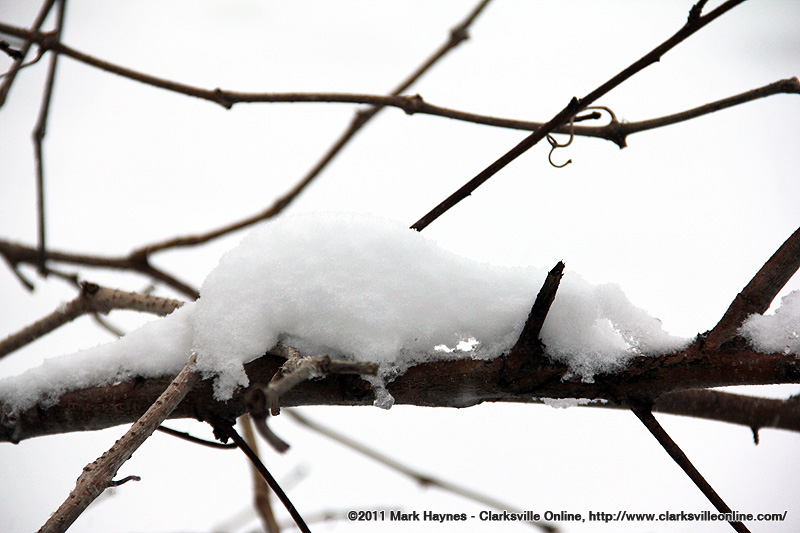
Snow building up on a limb can cause it to break.
Columnar plants have always had landscape appeal for a variety of reasons. For design purpose, they are dramatic and demand your attention. This makes them useful as a focal point, or to direct your gaze towards something, such as an entrance. They may also be functional where space is limited.
Columnar plants are sometimes called fastigiate or fastigiated. If you see the cultivar name ‘Fastigiata’ or ‘Columnaris’ it means a form was found that grew in a narrow upright form, and was selected and propagated to preserve this characteristic. Usually these are mutations that require vegetative propagation, such as grafting or cutting reproduction, since a seed grown version of the mutated plant would almost always revert back to the more typical form. There are a few exceptions to this rule, such as the columnar form of English oak, Quercus robur ‘Fastigiata’. If you sow acorns from one of these oaks, about three fourths of them will result in columnar trees. Pondering this made sleeping parts of my brain wake up and shake off a little dust. Fuzzy thoughts about Mendelian inheritance bothered me for a time, but I was able to escape them.
Columnar forms of maples, elms, magnolias, beeches, boxwoods, hornbeams, cedars, hackberries, yews, ash, ginkgo, holly, golden raintree, and sweetgum, can be found in the trade, just to name a fraction of the many. You can even find a fastigiate form of our state tree, the tulip poplar. It’s become a favorite for use on the Mississippi State campus.
In local landscapes, forms often found include Sky Pencil Japanese holly, fastigiate European hornbeam, and DeGroot’s Spire arborvitae.
If you wish to protect them from splitting under loads of snow or ice, it helps to wind twine around them to make a tight bundle. You have probably seen this done to Christmas trees. Of course this should be done before the storm approaches, and this winter it should have been done several weeks ago. In hindsight, I should have written this column back then as well.


Comments
Feel free to leave a comment...
and oh, if you want a pic to show with your comment, go get a gravatar!
You must be logged in to post a comment.