 Clarksville, TN – The economic data reports were mixed, but nonfarm payrolls rose more than expected (+280,000) in the initial estimate for May. Seasonal adjustment issues may have been a factor (as education job losses were a lot smaller than usual).
The unemployment rate edged up to 5.5%, but that partly reflected increased labor force participation for teenagers and young adults (also consistent with seasonal adjustment problems).
Mining, which includes energy exploration, fell by 17,200, down 68,400 since December.
 [1]
[1]Frazier Allen
In comparison, total payrolls rose by 3.06 million over the past 12 months. The strong payroll figures were viewed by the markets as bringing forward the timing of the first Fed rate hike (although officials will want to see a lot more data before pulling the trigger).
Consumer spending was flat in April. Ex-food & energy, the PCE Price Index rose 0.1%, up 1.2% y/y (still a long way from the Fed’s 2% target). Auto sales were reported to have risen sharply in May. However, improvement partly reflected a rebound from a “soft” April. In addition, the Memorial Day holiday fell a little earlier this year. That effectively created two weekends of heavy sales promotions (hence, we could see a setback in June).
Negotiation on Greece came down to the wire. It looked like the country was about to miss a debt payment, but the IMF agreed that it could ignore deadlines and make its various June payments all together at the end of the month. German 10-year bund yields were highly volatile, generating some turbulence in our bond market.
Next week, the lack of important economic news in the early part of the week ought to help reduce financial market volatility. The focus will be on retail sales. Why haven’t consumers spent the windfall from lower gasoline prices? One possible explanation is that the drop in gasoline prices has been seen as temporary (the “savings” less likely to be spent).
However, increased spending may show up with a lag. The May retail sales report (Thursday) should inform the debate. Attention will then turn to the Fed’s upcoming policy meeting (June 16th-17th).
Indices
| Last | Last Week | YTD return % | |
| DJIA | 17905.58 | 18126.12 | 0.46% |
| NASDAQ | 2095.84 | 2120.79 | 6.82% |
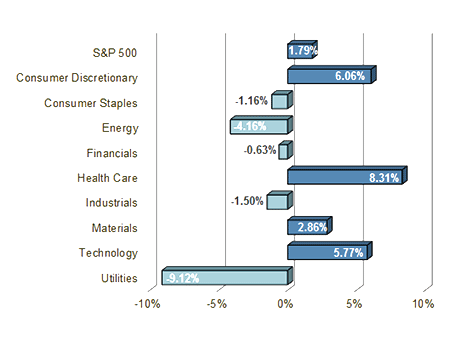
| S&P 500 | 2095.84 | 2120.79 | 1.79% |
| MSCI EAFE | 1903.57 | 1913.47 | 7.25% |
| Russell 2000 | 1251.29 | 1253.10 | 3.87% |
Consumer Money Rates
| Last | 1 year ago | |
| Prime Rate | 3.25 | 3.25 |
| Fed Funds | 0.13 | 0.08 |
| 30-year mortgage | 4.10 | 4.14 |
Currencies
| Last | 1 year ago | |
| Dollars per British Pound | 1.543 | 1.674 |
| Dollars per Euro | 1.136 | 1.362 |
| Japanese Yen per Dollar | 124.070 | 102.660 |
| Canadian Dollars per Dollar | 1.244 | 1.093 |
| Mexican Peso per Dollar | 15.582 | 12.937 |
Commodities
| Last | 1 year ago | |
| Crude Oil | 58.00 | 102.64 |
| Gold | 1183.34 | 1245.31 |
Bond Rates
| Last | 1 month ago | |
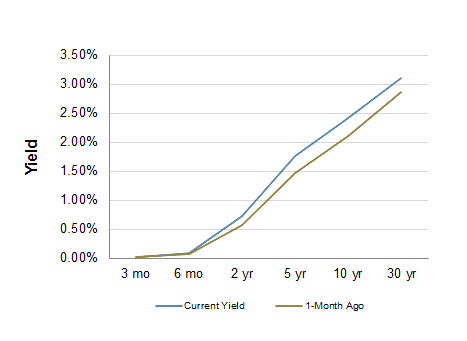
| 2-year treasury | 0.73 | 0.57 |
| 10-year treasury | 2.41 | 2.13 |
| 10-year municipal (TEY) | 3.59 | 3.45 |
Treasury Yield Curve – 06/05/2015
As of close of business 6/4/2015
 [2]
[2]
S&P Sector Performance (YTD) – 06/05/2015
As of close of business 6/4/2015
 [3]
[3]
Economic Calendar
| June 11th | — | Jobless Claims (week ending June 6th) Import Prices (May) Retail Sales (May) |
| June 12th | — | Producer Price Index (May) |
| June 15th | — | Industrial Production (May) |
| June 16th | — | Building Permits, Housing Starts (May) |
| June 17th | — | FOMC Policy Decision, Yellen Press Conference |
Important Disclosures
[320left]Past performance is not a guarantee of future results. There are special risks involved with global investing related to market and currency fluctuations, economic and political instability, and different financial accounting standards. The above material has been obtained from sources considered reliable, but we do not guarantee that it is accurate or complete. There is no assurance that any trends mentioned will continue in the future. While interest on municipal bonds is generally exempt from federal income tax, it may be subject to the federal alternative minimum tax, state or local taxes. In addition, certain municipal bonds (such as Build America Bonds) are issued without a federal tax exemption, which subjects the related interest income to federal income tax. Investing involves risk and investors may incur a profit or a loss.
US government bonds and treasury bills are guaranteed by the US government and, if held to maturity, offer a fixed rate of return and guaranteed principal value. US government bonds are issued and guaranteed as to the timely payment of principal and interest by the federal government. Treasury bills are certificates reflecting short-term (less than one year) obligations of the US government.
Commodities trading is generally considered speculative because of the significant potential for investment loss. Markets for commodities are likely to be volatile and there may be sharp price fluctuations even during periods when prices overall are rising. Specific sector investing can be subject to different and greater risks than more diversified investments.
Tax Equiv Muni yields (TEY) assume a 35% tax rate on triple-A rated, tax-exempt insured revenue bonds.
 [4]Material prepared by Raymond James for use by its financial advisors.
The information contained herein has been obtained from sources considered reliable, but we do not guarantee that the foregoing material is accurate or complete. Data source: Bloomberg, as of close of business June 4th, 2015.