 Clarksville, TN – Have you seen the old stone building on Walker Street in the New Providence area? If not, come by and take a look at it some time. This primitive looking building, labeled “Sevier Station”, is on the National Register of Historic Places and is touted as the oldest building in Montgomery County, Tennessee.
As you walk around and gaze at the roughhewn limestone quarried from the nearby bluffs, and ponder the old chimney placed oddly in the center of the building, and consider the apparent gun port built into the east side, may you contemplate the ground upon which you are standing.
 [1]
[1]Sevier Station
This building sits upon part of the original 640 acres of land that 18th century pioneers, the Sevier family, purchased and inhabited over 220 years ago, shortly after the Revolutionary War.
It is beautiful land – a property with inspiring views of the confluence of the Red River and the Cumberland and also downtown Clarksville. In 1790 it was found to contain springs, fertile soil for crops, and plenty of timber. Yet, this is also land upon which blood was spilt; aggression and hatred boiled over, and lives were devastated.
It represents an idea, a daring dream, and the very epitome of the struggle that was westward expansion. It is part of why you now live where you live, and why this place even exists as it does at all. There would be no Clarksville, Tennessee and places like it if it were not for pioneer families, such as the family of Valentine Sevier.
If you can, imagine Middle Tennessee over two centuries ago and the way it was during the time that families such as the Seviers, the Bells, the Bowens, the Manskers, the Bledsoes, the Robertsons, the Shelbys and so many others embarked upon their treacherous journeys from the infant settlements on the western side of the Appalachians. They were likely full of both hope and ideas, but also imbued with much trepidation.
 [2]
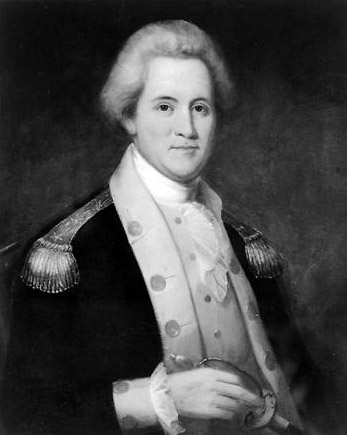
[2]John Sevier, brother of Valentine and the first Governor of Tennessee.
During this time of expansion, there were a handful of families that settled the area we now call Clarksville, Tennessee. Definitely, one of the most prominent and respected of these families was the Seviers. Valentine was the younger brother of the famed John Sevier, who would later become the first governor of the state of Tennessee.
Valentine married Naomi Douglas in Virginia in approximately 1767. Their family eventually consisted of 14 children: Elizabeth (1768), John (1769), Ann (1771), Valentine, Jr. (1773), the twins Robert and William (1775), James (1777), Jemima (1778), Mary (1781), Rebecca (1782), Joanna (1784), Abraham (1786), Joseph (1788), and last of all, Alexander (1790) who was most likely born at some point as the family traveled to their new home on Red Paint Bluff overlooking the newly established town of Clarksville.
Prior to their arrival, they had boldly left Virginia (Shenandoah County) in approximately 1771 and become members of the illegal Watauga settlement (which is now located in present day northeastern Tennessee) and then also participated in the failed State of Franklin. This is the area in which they lived leading up to the Revolutionary War and thereafter.
During this time Valentine and his brothers fought at the famed battle of King’s Mountain (among others) and also fought the Cherokee in the Overhill Expeditions. The history of this family is filled with a continuous pattern of stories of adventure, ambition, risks, and warfare.
[320right]Due to this fact, it is not surprising that Valentine decided to embark upon a new venture. When the decision was made that the family would uproot and then settle along the Cumberland, their oldest son, John was the only child who did not accompany them to Clarksville, but remained behind in the Sycamore Shoals area.
Also, by the time of their arrival in Clarksville, their two oldest daughters had married and thus the family had expanded further with two son-in-laws and then shortly thereafter two grandsons who were most likely born at their new home, Sevier Station.
It is difficult to imagine what scenes greeted the eyes of the Seviers in 1790 as they arrived at the confluence of the Red and Cumberland Rivers. This settled and developed place that we experience today was then profoundly untamed, untouched for all intents and purposes, and raw with natural beauty. Don’t you think it would be amazing to be able to see this area as it was before Euro-American settlement?
The conveniences we take for granted were nowhere in sight! Transportation could be extremely difficult as there were no paved roads and certainly no interstates. The functions of daily life were cumbersome as there were no power lines bringing ease and technology to everyone, and no neighborhoods with modern homes and running water. Basic supplies and needs could most assuredly not be met by a quick jaunt to the local Wal-Mart or Target!
 [3]
[3]Drifting Downriver – by David Wright. (www.davidwrightart.com [4])
Instead, there were vast and seemingly endless miles of rugged frontier and untouched and ancient forests; most easily navigated by travelling the rivers upon flat boats and canoes. Upon the shores, there were black bears, and also an abundant population of buffalo. Predators such as mountain lions and wolves were common.
The forests were teeming with beaver, raccoon, opossum, turkey, fox, and deer and predominantly dense with the growth of oak and hickory trees, but also elm, maple, black walnut, sycamore, and cottonwoods. The river was framed by large cane breaks almost nonexistent today.
At that time Clarksville was so new it barely existed. It had officially been surveyed and established in 1785; and log homes made from the materials found along the Cumberland had just begun to emerge on that hill overlooking the river.
[320left]The new homes, which must have been easily visible from Sevier Station, were just above the flood plain on the ground that would later become known as downtown Clarksville. This time was so long ago, these original structures no longer remain. These first log cabins usually were constructed of puncheon roofs and floors (rough wooden planks made by splitting a log in the middle and then placing the split logs with the rounded sides down).
Surprisingly to those of us living in the 21st century, many times these cabins were not much larger than a 12 x 12 room with a loft. If they were lucky the room might even be as big as 20 x 20. They were usually made with a stone chimney with a very large hearth sometimes with enough space for cooking large game over the fire.
Cabins were used mostly for storage, sleeping, and shelter during extreme weather as most work and activities took place outside. These folks were busy people! Their lives were full of activity and work throughout the day.
Most settlements along the Cumberland, called stations, were comprised of a collection of buildings, sometimes stockaded, but in the case of Sevier Station, this was not so. Stations each had a blockhouse for protection. This building was two stories with gun ports in the top story for use if the station were under siege.
 [5]
[5]Reconstruction of a blockhouse within a stockaded frontier station, Manskers Station, Goodlettsville, TN.
Most blockhouses were built from timber, but a trend towards building with stone had begun along the Cumberland during the late 18th century due to the propensity of the Native Americans to burn the settlers’ homes and blockhouses.
Sevier Station was an atypical station for its time. Apparently, it was merely a collection of several homes, a blockhouse, and most likely, several out buildings; the exact number can no longer be determined. It also contained a blacksmith shop, run by Valentine’s son-in-law, Charles Snyder. There were at least three family units living at the station, all related to Valentine Sevier, as well as slaves, apprentices, and at times, additional militia men for protection. The station must have been bustling daily with activities related to the mere survival of its inhabitants.
These early settlers were far from civilization and had to rely upon local resources and their own skills to meet the needs of the family. For example, to clothe the family small crops of cotton or flax were grown. Many times wool was used as well. Then the various fabrics were dyed with the use of local plants.
Men wore knee-length breeches during the colonial period usually made of leather for those living on the frontier, simple shirts made of homespun linen, shoes made of leather with wooden soles and connected to the uppers by wooden pegs, and of course tricorn hats were common along with slouch hats. Buttons were made of bone, shell, or pewter and women wore petticoats, gowns, and underneath, were supported by stays. Most women covered their heads with cloth caps to protect their hair from dirt and thus lessen the need for washing it.
Frontier families subsisted on the hunting of local game along with the use of limited amounts of livestock they could bring with them. They searched for local edible plants, but also brought with them seeds to create a family garden. Most importantly, clearing land and planting corn as soon as possible for use as a staple was essential for the family’s success.
 [6]
[6]A Good Day’s Hunt – by David Wright. (www.davidwrightart.com [4])
The original Euro-American settlers such as the Sevier family faced many threats in their endeavors to create communities and businesses along the Cumberland River. Yet, the most threatening issue of all was not the task of building a town or the isolation from civilization; it was the Native Americans – natives with whom there had become a complicated history of conflict and treaties: the Chickasaw, the Creeks, the Delaware, the Shawnee, the Cherokee – and the most problematic for the settlers, the group called the Chickamauga.
The Chickamauga Confederacy was comprised of various factions from many tribes who all had one thing in common – a willingness to resist Euro-American encroachment with violence and to the death! They were a passionate group of people who were definitely not willing to cede any more ancient hunting grounds to land hungry settlers. In their minds there was absolutely no room along the Cumberland for log cabins, fields of crops, and most of all white men with their guns claiming ownership.
Yet, the conflict was not as simplistic as an encroachment upon hunting grounds. There were intricate and complicated relationships between the Native Americans, the French, and the Spanish as well. Everyone wanted a foothold and each group had different motivations and interests which contributed to the conflict and violence. Seeking to untangle the reasoning behind many of the atrocities that took place between the Euro-Americans and the Native Americans during this time is complicated.
[320left]The result was horrific; there were hundreds of deaths of white men, women, and children during the waning years of the 18th century near the settlements along the Cumberland River. Clarksville’s tragic story of the Sevier family is just one of many.
Yet, one thing is for sure, the Native Americans were on the defense and the Euro-Americans on the offense. They were definitely being intruded upon as the settlers sought land rights, wealth, opportunity, and domination. Despite the horrific attacks and murder that occurred during this period, one could argue that it was the Native Americans, not the settlers who were most threatened in the situation.
There are multiple stories and multiple points of view contained within the history of westward expansion, and many times it is hard to draw conclusions! Despite the way these stories have been depicted in the past, there are no easy heroes and villains here.
Westward expansion initially created immense suffering for all involved. And our present lives here in Clarksville, Tennessee exist upon a foundation created by both the heroic and shameful deeds of those souls of the past. Yet, if the Sevier family and, of course, settlers like them, had not pushed west, a different reality would now exist – a reality that is hard to imagine. Who would be living in this place? Would this alternate reality have been better than what we are experiencing?
It is impossible to know; yet the idea is still a valuable one to consider. It is a reminder that the choices we make today actively create both the history and reality of those who will live in the future. We then have a choice to either live mindlessly or to use this knowledge of the past to contribute to the future consciously with goodwill, respect, and hope.
What can we learn from the early days of Clarksville, Tennessee and the lives, the choices, and the attitudes of those early settlers such as Valentine Sevier? And what about the broader questions and lessons to be learned; what conditions in the world amongst peoples create conflict and tragedies… these living hells? What can we learn from their stories?
Coming Soon
Part 2: Revisiting the Massacre at Sevier Station; In Their Own Words.
The artwork by David Wright used by permission. To see more of Wrights work, visit his website at www.www.davidwrightart.com [7]