 Clarksville, TN – Financial market participants seemed to care little about Putin’s annexation of Crimea, but freaked out following a Yellen comment taken out of context. An upside surprise in the Philadelphia Fed Index help restore positive sentiment in equities.
As was widely expected, the Federal Open Market Committee tapered the monthly pace of asset purchases by another $10 billion (to $55 billion beginning in April).
 [1]
[1]Frazier Allen
Also as anticipated, the FOMC abandoned the 6.5% unemployment rate threshold in its forward guidance on short-term interest rates.
Fed policymakers will look to a range of economic indicators, the inflation outlook, and financial market conditions in deciding to raise the federal funds target rate, but the FOMC indicated that it will likely be “a considerable period” after the asset purchase program (QE3) ends (4Q14 if the economy continues to evolve as anticipated).
In her press conference, Fed Chair Janet Yellen was asked about the time between the end of QE3 and the first hike in the federal funds rate. She gave a nuanced answer – essentially, “it depends.” However, within her answer, she suggested that a considerable period “probably means something on the order of around six months or that type of thing.”
That would put the first rate hike in April or June of next year. That has long been the consensus view of economists. However, some market participants had thought that the first rate increase might not come until 2016 so they had to adjust their expectations toward the consensus.
Still, nothing is written in stone. The Fed will react to changing economic conditions. For example, as Yellen noted, a continued low trend in inflation would push a rate hike further out.
Next week, a number of economic reports have market-moving potential, but none of the releases will alter the overall outlook for the economy or monetary policy. Note that new home sales and durable goods orders are volatile even when weather isn’t an issue. The data for the following week (March ISM and nonfarm payrolls) will be much more important.
Indices
| Last | Last Week | YTD return % | |
| DJIA | 16331.05 | 16108.89 | -1.48% |
| NASDAQ | 4319.29 | 4260.42 | 3.42% |
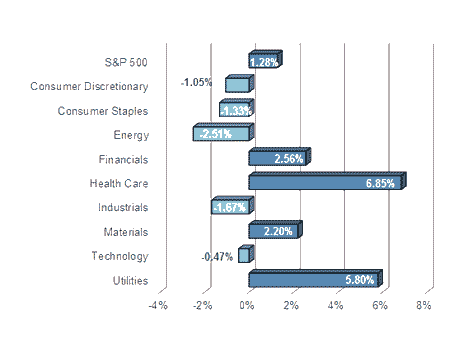
| S&P 500 | 1872.01 | 1846.34 | 1.28% |
| MSCI EAFE | 1864.01 | 1889.43 | -2.69% |
| Russell 2000 | 1198.97 | 1176.74 | 3.04% |
Consumer Money Rates
| Last | 1-year ago | |
| Prime Rate | 3.25 | 3.25 |
| Fed Funds | 0.08 | 0.18 |
| 30-year mortgage | 4.32 | 3.54 |
Currencies
| Last | 1-year ago | |
| Dollars per British Pound | 1.650 | 1.513 |
| Dollars per Euro | 1.378 | 1.294 |
| Japanese Yen per Dollar | 102.480 | 95.660 |
| Canadian Dollars per Dollar | 1.124/td> | 1.025 |
| Mexican Peso per Dollar | 13.265 | 12.392 |
Commodities
| Last | 1-year ago | |
| Crude Oil | 99.43 | 92.96 |
| Gold | 1330.62 | 1607.34 |
Bond Rates
| Last | 1-month ago | |
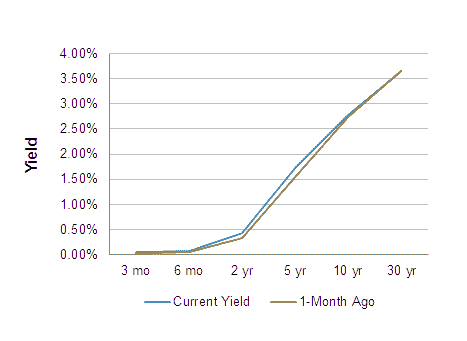
| 2-year treasury | 0.44 | 0.32 |
| 10-year treasury | 2.78 | 2.75 |
| 10-year municipal (TEY) | 4.43 | 4.46 |
Treasury Yield Curve – 3/21/2014
 [2]
[2]S&P Sector Performance (YTD) – 3/21/2014
 [3]
[3]
Economic Calendar
| March 25th |
— |
Case-Shiller Home Price Index (January) New Home Sales (February) Consumer Confidence (March) |
| March 26th |
— |
Durable Goods Orders (February) |
| March 27th |
— |
Jobless Claims (week ending March 22nd) Real GDP (4Q13, 3rd estimate) |
| March 28th |
— |
Personal Income and Spending (February) |
| April 1st |
— |
SM Manufacturing Index (March) Motor Vehicle Sales (March) |
| April 3rd |
— |
ISM Non-Manufacturing Index (March) |
| April 4th |
— |
Employment Report (March) |
| April 30th |
— |
Real GDP (1Q14, advance estimate) FOMC Policy Decision (no press briefing) |
Important Disclosures
[320left]Past performance is not a guarantee of future results. There are special risks involved with global investing related to market and currency fluctuations, economic and political instability, and different financial accounting standards. The above material has been obtained from sources considered reliable, but we do not guarantee that it is accurate or complete. There is no assurance that any trends mentioned will continue in the future. While interest on municipal bonds is generally exempt from federal income tax, it may be subject to the federal alternative minimum tax, state or local taxes. In addition, certain municipal bonds (such as Build America Bonds) are issued without a federal tax exemption, which subjects the related interest income to federal income tax. Investing involves risk and investors may incur a profit or a loss.
US government bonds and treasury bills are guaranteed by the US government and, if held to maturity, offer a fixed rate of return and guaranteed principal value. US government bonds are issued and guaranteed as to the timely payment of principal and interest by the federal government. Treasury bills are certificates reflecting short-term (less than one year) obligations of the US government.
Commodities trading is generally considered speculative because of the significant potential for investment loss. Markets for commodities are likely to be volatile and there may be sharp price fluctuations even during periods when prices overall are rising. Specific sector investing can be subject to different and greater risks than more diversified investments.
Tax Equiv Muni yields (TEY) assume a 35% tax rate on triple-A rated, tax-exempt insured revenue bonds.
 [4]Material prepared by Raymond James for use by its financial advisors.
The information contained herein has been obtained from sources considered reliable, but we do not guarantee that the foregoing material is accurate or complete. Data source: Bloomberg, as of close of business March 13th, 2013.
©2014 Raymond James Financial Services, Inc. member FINRA [5] / SIPC [6].